
Paul KirbyEurope digital editor

 dpa/Alamy Live News
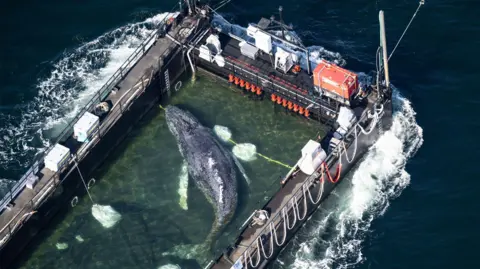
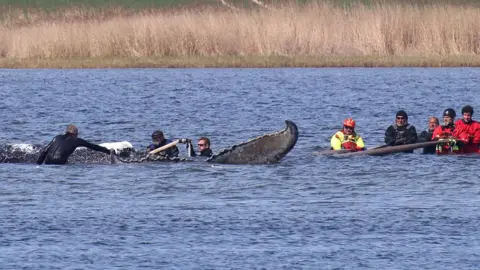
More than five weeks after a humpback whale became stranded in shallow waters on the German coast, a barge has ferried the animal out of German waters, en route to the North Sea.
The final operation to save the whale is being closely followed across Germany, after the failure of earlier attempts to lure it away from the coast.
The whale was coaxed into the water-filled barge on Tuesday, in a mission funded by two German entrepreneurs.
Marine experts have largely distanced themselves from the operation. An expert International Whaling Commission panel said such plans were well meant, but the animal looked “severely compromised and unlikely to survive even if moved to deeper water”.
Despite the scepticism surrounding the whale’s fate, those involved in the operation were delighted with its success.
For many, Till Backhaus, the environment minister in the northern state of Mecklenburg-Vorpommern, has become the face of the rescue mission. Hailing the operation as a success, he said it was an “example for Germany of what can be done”.
“If everything goes well, it will be in the North Sea in two days,” he told reporters, adding that the whale was doing very well and reportedly even sang during the night.
The two entrepreneurs who funded the rescue were delighted the whale had been saved from shallow waters near the island of Poel where it had spent the past 29 days.
 Danny Gohlke/AFP
“I can’t even say how happy I am,” said Karin Walter-Mommert, while Walter Gunz said he had never prayed so much in his life.
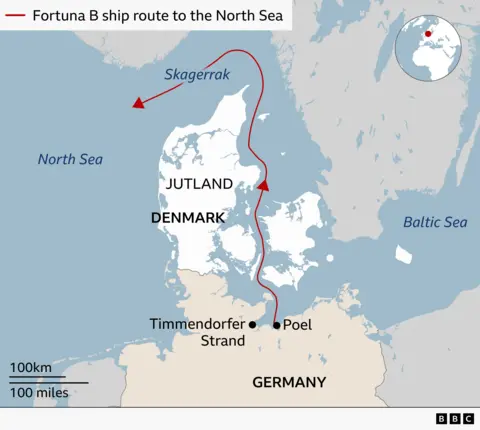
Once the transport ship Fortuna B towing the whale left German waters, it headed through the Baltic Sea into Danish waters, sailing along the Danish coast of Jutland with the aim of heading through the Skagerrak strait towards the North Sea.
There was a mood of euphoria among the rescue team that began on Tuesday when the whale swam into the specially adapted barge and it was still evident when they spoke to reporters on Wednesday.
Felix Bohnsack, the technical head of the mission, praised everyone involved, from Backhaus’s environment ministry to the German life guards’ association DLRG, although he warned they were not yet “out of the woods”.
Wildlife groups are far from optimistic about the whale’s future once it is eventually released into the North Sea.
Whale and Dolphin Conservation (WDC) was especially downbeat, warning that the whale had no long-term chance of survival. It is known to have suffered skin damage because of the lack of salinity in the waters along Germany’s Baltic Sea coast and WDC said its skin would need to fully recover and it would need to start finding food independently for any rescue to be considered a success.
Marine biologist Fabian Ritter was more positive, telling German press agency DPA that it clearly had a “will to live”, but he warned that this type of rescue mission was unprecedented: “We don’t know what effect this will have on the whale.”
The German Oceanographic Museum warned that the whale was at risk of drowning because it was so weak.
The whale’s troubles appear to have started when it became entangled in netting. Although it was first spotted early last month, it was on 23 March that it first became stranded on Timmendorfer Beach in Lübeck Bay.
It has been a cause celebre in Germany ever since. When a channel was eventually dug for the whale to swim free, it went further east along the coast to Wismar Bay and by the end of March he ended up in a shallow area off the island of Poel, where it remained until Tuesday’s rescue.
Some among the rescue team and German media have given the whale nicknames: either Timmy, after the beach where he first stopped on the German coast in late March, or Hope.
Reflecting on the past 24 hours, rescue director Felix Bohnsack said on Wednesday that “the moment Hope swam into the barge was inconceivable; we had tears in our eyes; these are images I will never forget”.