

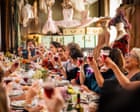
If we are being honest this comedy-drama set in a costume atelier in 1970s Rome is a little light on the comedy, while the drama is decidedly on the melo end of the scale, even a bit absurd at times. But there’s something about it that is irresistible, especially if you are in any way sympathetic to queer-accented celebrations of women played by powerhouse ensembles in the spirit of George Cukor’s The Women, François Ozon’s 8 Women, or Pedro Almodóvar films. You will also have a ball if you like luscious-looking period costumes – this one is completely awash in them, specialising in 18th-century silhouettes and 1970s prints – with lust-inducing shots of bolts of silk fabric billowing out in slanting sunlight; as well as the haberdashery porn of carefully categorised button collections; and the camaraderie of collective craftsmanship, especially seamwork. To add to the list there is mouthwatering footage of food, scenes where women bicker one minute and then hug it out the next in sisterly fashion; the occasional studly male who walks cluelessly through the action to either be ogled or provide a baritone or tenor voice for a communal singsong to vintage 70s Italian ballads.
Nevertheless, it is essentially a fluffy work from director Ferzan Özpetek (Hamam, Facing Windows); he is no Almodóvar, but you can tell this comes from a place of love and sincerity for him, as well as familiarity given he’s spoken in interviews how the inspiration for this were his visits to costume studios around Rome in the 80s when he was just starting his film career as an assistant director. In this fictional version of that world, set in 1974, sisters Alberta (Luisa Ranieri) and Gabriella (Jasmine Trinca) run just such a studio, staffed by a few dozen seamstresses and supplemented by a dyeing specialist (Nicole Grimaudo) and an in-house cook/nonna figure (Mara Venier).
In the framing device that kicks off the film, Özpetek himself gathers his cast for a read-through and one of them (Geppi Cucciari) describes this majority female assemblage as a “vaginodromo”. There’s certainly lots of girl-on-girl tension, as the company struggles to manage deadlines and balance budget with beauty, especially when they win the commission to make all the costumes for an 18th-century-set feature film. It is designed by visionary Bianca Vega (Vanessa Scalera), who may or may not be somewhat inspired by the legendary costumier Milena Canonero, who designed Barry Lyndon and Marie Antoinette, among many other fabric-tastic features. Feelings run particularly hot between buttoned-down, business-minded Alberta and her grief-damaged sister Gabriella, which is only one of the many soapy subplots vying for attention. A battered wife (Milena Mancini) is urged by the others to defy her husband, a political protestor has a natural gift for passementerie and decoupage (Aurora Giovinazzo), and a little boy (Edoardo Stefanelli) whose mother can’t afford to buy him pencils or after-school care has to spend afternoons hiding in the button closet.
The film runs for 135 minutes, but the script is so breathless it never feels draggy and Özpetek gets excellent results with his stacked cast. It of course helps that the costumes designed by Italian journeyman Stefano Ciammitti (Io Capitano) convince throughout, apart from maybe the delightfully bonkers climactic dress design for the movie-within-the-movie – all sculptural scroll motives and cellophane sweet wrappers that looks more like something dreamed up by Daniel Lee for a Schiaparelli haute couture show than an actual, working film costume.