

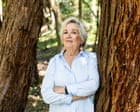
Jane Caro is happy to call herself privileged. She does so only minutes after inviting me into her federation home on Sydney’s lower north shore, complete with heritage glass windows and a leafy back garden.
“I know what a privileged and fortunate person I am,” she says, donning a wide-brimmed hat and sunglasses. It may be autumn, but Sydney continues to be hot and sticky – thanks, Caro notes, to our changing climate.
“I have a responsibility to … use that privilege to advocate for people who don’t have it, because privilege also makes you safe.”
Weaving down her neighbourhood’s tree-lined backstreets and past manicured front lawns, she muses: “There’s less risk involved in me speaking out than someone who might lose their job or opportunities. I’m sure I’ve lost opportunities [for my advocacy]. I’ve also gained them. But I can afford to lose them.”
Caro’s career is difficult to surmise succinctly. She spent decades in marketing and advertising before turning to social commentary, broadcasting, writing, lecturing and, for a brief stint, politics. In her 60s, she published her first adult novel, The Mother, a domestic thriller which propelled her to a new career as an author.
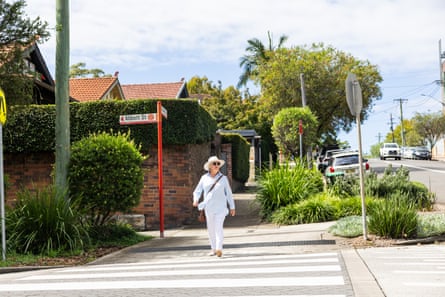
Her second crime novel, Lyrebird, was released last year, and a third is on the way. She can’t talk about it, except to say at its heart is social justice (The Mother and Lyrebird also raised issues of gender-based violence and climate change).
Meanwhile, she continues to be an outspoken feminist, atheist and proponent of public education, which brings us to her latest publication: Rich Kid Poor Kid, to be released next month.
It is a scathing critique of Australia’s longstanding support for private education and the notion of choice to the detriment of our public schools, where enrolments are at record lows.
“I think it’s appalling that you can’t just go to your local public school now and feel sure that you’ll get an excellent education,” she says.
“We have schools in Australia that can’t afford to buy cleaning products for their cleaners, and the teachers have to dip into their own pockets to buy it. This is outrageous on every level. It cannot be justified.”
Caro says her lifelong passion for the public education system stemmed from her mother’s strong views about schools being the “litmus test” of a society’s civil values and cohesion.
Her family moved to Australia from the UK when she was five, and Caro was educated entirely in public schools, first at Frenchs Forest public, then Chatswood public and Forest high.
“I had a really first-class public school education … And then I got a free university education,” she says.
“I feel like I owe [back] for the education that I was lucky enough to get. I also feel that [a public education] was valuable, not just from the point of view of getting really good marks at university.
“And frankly, I got perfectly ordinary marks. I’ve always stuck true to the idea that Ps get degrees and fun is a valid part of life.”
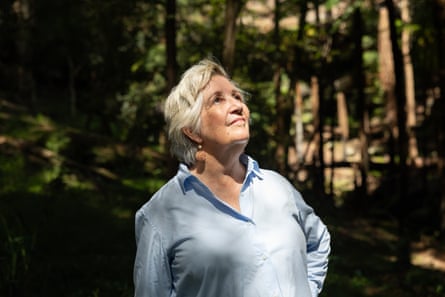
Caro’s two daughters were educated in the public system – albeit in the affluent suburb of Mosman where the public school offering is strong – and so was every member of her extended family.
One of her daughters now works as a counsellor at a public school. Asked if her three, soon to be four, young grandchildren will follow in her family’s footsteps, Caro replies drily: “They bloody better.”
I ask her if it was a difficult decision to opt for a public high school for her children. In her essay, Caro describes the anxiety of choice that parents face after their children’s primary school years, one she says is primarily about buying status than accessing a better education.
Was that something she also navigated?
“No,” she replies briskly. “I mean, first of all, look where I live. Leafy middle-class north shore Sydney … When I sent them to high school, yes, I underwent the usual abuse that you face when you’re asked what schools you’ve put your kids’ names down for, and I said, ‘None, I’m not a fucking idiot.’
“Well I didn’t say it quite like that, but people told me I was going to condemn them to a life of drug addiction and prostitution, which was absurd.”
As Caro puts it, the reason people denigrate public schools is simple. “If you’ve paid 5, 10, … 45, $50,000 plus for something you can get for next to nothing down the road, you have to say what’s down the road is absolute shit,” she says.
“Public schools haven’t failed. We, the public, have failed public schools.”
The current Labor government has enacted a deal with the states and territories to fully fund public schools according to the Schooling Resource Standard – but not until 2034, leaving a generation of students underfunded.
At the same time, successive governments continue to provide funding to private schools regardless of the fees they charge families, a choice Caro says comes down to the Labor party drinking “the neoliberal Kool-Aid almost as enthusiastically as the Liberals”.
“This is this idea of choice and merit … the free market can solve every problem,” she says. “All that self-serving, privileged class horseshit. They drank it … And the problem for the Australian public school system is it has no champion in parliament apart from the Greens and they are not going to form a government anytime soon.”
Caro, who will be 70 next year, delivers this speech while tackling the lower north shore’s many hills and winding staircases with the stamina of a 25-year-old.
“No shortage of hills in Sydney,” Caro comments. “Which is why walking is an excellent exercise. It keeps you fit.”
We share a terrible sense of direction, and so stick to the stable path of the Flat Rock Gully creek, popping out at the historic Cammeray Bridge.
It is here we plan to meet Guardian Australia’s photographer, but instead decide to stop for a coffee and hide from the heat.
It’s split-second decisions such as this that Caro compares to how she has approached her long career. “I never have a plan,” she says. “I just say yes to interesting offers and keep going.”
In her early days in advertising, Caro says she was one of just a handful of women in the industry, who were constantly teased and dismissed by the men.
“The level of insecurity and fragility, I felt embarrassed for them frankly,” she reflects.
“But I’m glad really because now if somebody tries to put me down or abuse me on Twitter, I just say, ‘I spent 35 years in advertising creative departments. I’ve been bullied by the wittiest men in Australia.’”
Nevertheless, she says, she enjoyed her advertising career. “It also enabled me to live a nice, comfortable life, which has enabled me to concentrate on the things I really want to do,” she says, and that word comes up again.
“That’s a gift and a privilege. A huge privilege, another one. I’m just overwhelmed with privilege, I can tell you.”
It hasn’t all been easy. Caro suffered from crippling anxiety from the age of 21, which she says she now does not experience at all thanks to extensive therapy and coming face to face with any parent’s greatest fear.
“It took real danger when my first daughter almost died to chase fantasy-danger out of my head,” she says.
When Caro’s baby, who had been born five weeks premature, was just 13 days old, she contracted RSV-positive bronchiolitis, a severe viral chest infection that caused her to temporarily stop breathing three times in one night.
She was given the last neonatal intensive care bed in New South Wales at the time, and an intensive care doctor and grief counsellor gave her powerful advice that has remained with her since: “‘There’s nothing special about you. There’s nothing special about my daughter. Terrible things can happen. They can happen to anyone. Safety is an illusion. Danger is reality.’”
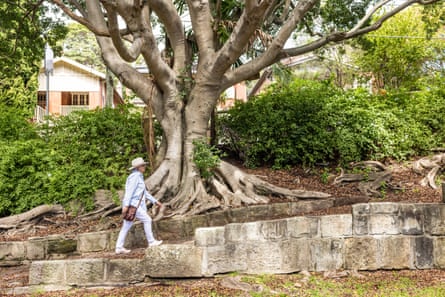
“I spent a lot of time trying to control everything, keep everything safe, which didn’t fit with my personality,” she says. “Now I often joke, I’m so not anxious that some people may think I’ve overcorrected.”
Her child made a full recovery – and now Caro can’t remember the last time she felt nervous.
En route to the cafe, we pass the playing fields of the Anglican boys’ school Shore – one of those $45,000-plus a year schools. It’s complete with five full-sized ovals, tennis courts, pavilions and dressing rooms.
“Absolute temple of privilege,” Caro mutters.
The conversation turns back, of course, to social justice and equality of opportunity.
“You can’t talk about excellence. You can’t talk about merit. You can’t talk about any of those things if the playing field is rigged. And it’s rigged.”